amazon leo internet speed
amazon leo internet speed is attracting attention because Amazon has shown that its low Earth orbit network is being built for high capacity connectivity, not only basic rural browsing. The most public figure so far is the Amazon Leo Ultra terminal, which Amazon says can support downloads up to 1 Gbps and uploads up to 400 Mbps for enterprise-grade use. That is a major headline, but Kenyan customers should read it carefully. Terminal capability, real-world plan speed, country capacity, installation quality, and user demand all affect the final experience.
This guide explains what the speed claims mean, what remains unknown, and how Kenyan homes and businesses should compare Amazon Leo with existing satellite and terrestrial options. The goal is not to promise a speed that Amazon has not packaged for Kenya. The goal is to help you understand the difference between a technical maximum and a reliable everyday connection for Zoom, CCTV, Netflix, school platforms, cloud backups, M-Pesa systems, and office work.



amazon leo internet speed: official figures and practical meaning
Amazon’s official enterprise preview announcement says Leo Ultra is a production phased-array terminal designed for demanding business and public sector applications, with download speeds up to 1 Gbps and upload speeds up to 400 Mbps. The announcement is available on the Amazon Leo Ultra page. Those numbers are important because they show Amazon’s performance ambition, especially for enterprise networks, remote operations, cloud workloads, and locations where fibre is unavailable.
However, a maximum figure is not the same as a guaranteed residential plan. A user in Kenya will need to know the terminal type sold locally, the plan tier, any data policy, the number of active users in the cell, and whether Amazon has enough local and regional capacity. LEO internet is shared infrastructure. When many terminals use the same satellite coverage and ground network during peak hours, speeds may vary. A properly mounted dish also matters because obstruction can reduce performance and cause interruptions.
amazon leo internet speed for homes and businesses
For a home, speed is usually judged by streaming, video calls, downloads, gaming, school work, and general browsing. For a business, the same connection must also support point of sale, inventory systems, CCTV, guest WiFi, staff devices, VoIP calls, cloud accounting, and backups. The amazon leo internet speed that matters is the stable speed during the busy hours of the day, not only the highest number seen in a test.
Kenyan buyers should compare Amazon Leo with current options using real workflows. If your site is in an estate with strong fibre, fibre may still offer lower cost per Mbps. If your site is on a farm, lodge, border post, mining area, construction camp, or remote school, LEO satellite may be the only realistic path to high-speed broadband. Our Starlink Kenya speed and latency guide explains the same practical issues that future Amazon Leo users will need to check.
Why LEO networks can feel faster than older satellite internet
Traditional geostationary satellite internet uses satellites very far above the earth. That distance creates high latency, which makes video calls, VPNs, gaming, and remote desktop sessions feel slow even when download speed is acceptable. Low Earth orbit systems like Amazon Leo place satellites much closer to the ground. The shorter path can reduce latency and make interactive applications feel more responsive.
Speed is only one part of experience. A 50 Mbps low-latency link can feel better than a higher-latency connection for meetings and online work. Upload speed is also critical. Many internet packages are marketed on download speed, but Kenyan businesses increasingly need upstream performance for cloud cameras, file uploads, remote backups, live classes, telemedicine, and video meetings. The Amazon Leo Ultra upload figure is therefore notable, even if consumer upload plans are not yet published.
Amazon is also designing private networking features for enterprises, including connections to AWS and private networks. That is less relevant for a single home but very relevant for banks, logistics companies, hospitals, county systems, media teams, and energy operations. If those services become available in Kenya, Amazon Leo could be positioned not only as a rural internet product but also as a managed connectivity layer for serious operations.
Installation quality affects speed
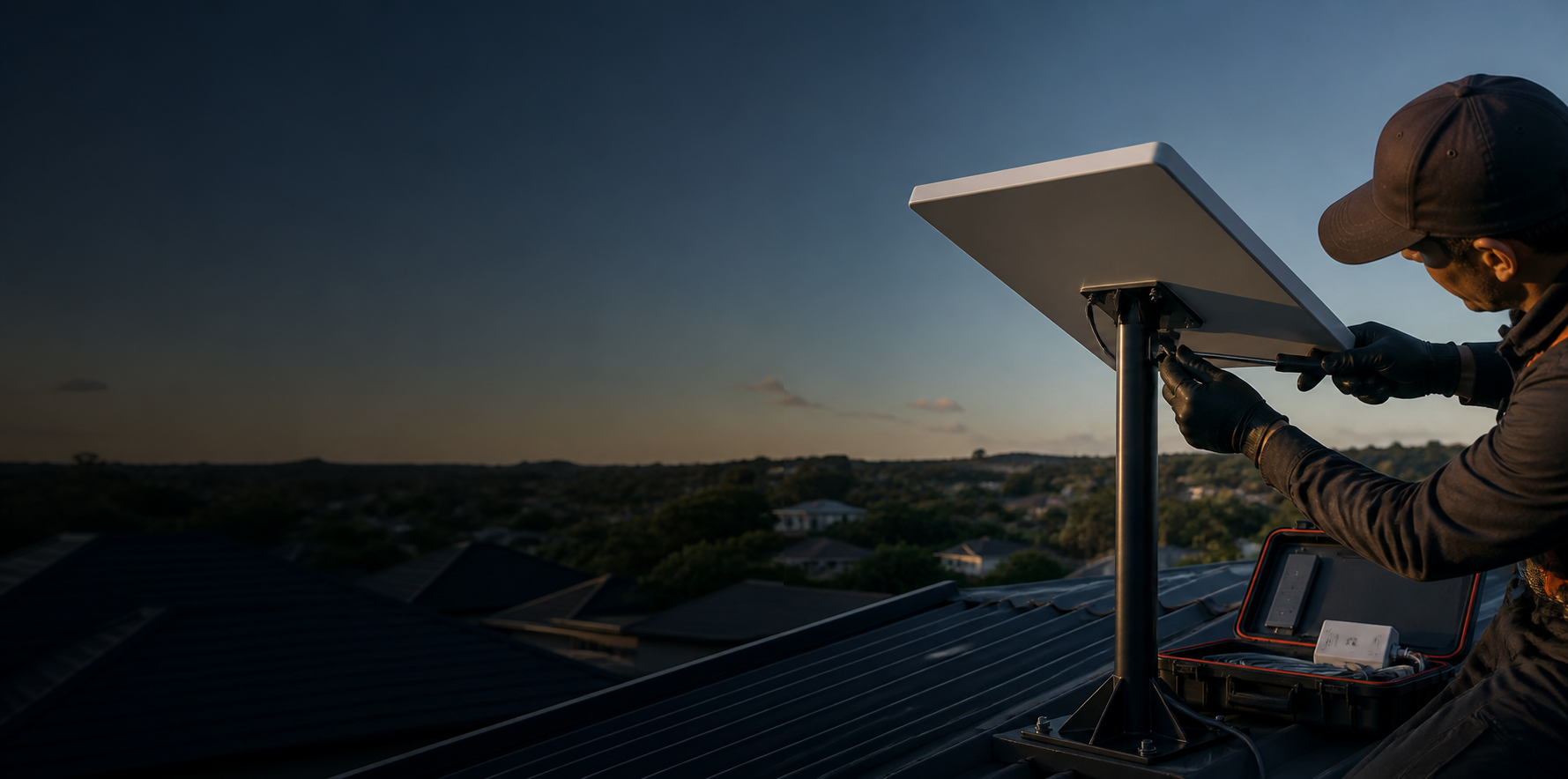
Even the best terminal cannot perform well if it is installed poorly. A satellite internet dish needs a clear sky view and a stable mount. Trees, tall buildings, roof edges, water tanks, and power poles can create obstructions. In LEO systems, the dish tracks many satellites over time, so an obstruction in one part of the sky may cause intermittent problems even if the connection looks fine for a few minutes.
Kenyan properties also need practical cabling and power planning. Long cable runs, weak power, poor earthing, missing surge protection, and badly placed routers can make users blame the satellite when the real bottleneck is local. For immediate installations, our Starlink Kenya installation guide and business internet guide show the type of planning that will also apply when Amazon Leo kits become available.
WiFi distribution is another common speed issue. A fast terminal installed on the roof does not guarantee fast WiFi in every room or guest area. Thick walls, metal roofs, long corridors, separate cottages, and outdoor spaces may require mesh systems or access points. Hotels, lodges, and offices should design the local network before judging satellite speed. The internet link and the building network must work together.
How Amazon Leo may compare with Starlink speeds
The comparison between Amazon Leo and Starlink is natural because both are LEO satellite internet systems. Starlink has the advantage of live market experience and an existing user base in many countries, while Amazon Leo is still moving through deployment and preview toward wider commercial service. Amazon’s highest published enterprise terminal speed is impressive, but the real comparison will depend on local packages, prices, capacity, support, and installation availability.
For a broader market view, read Compare Starlink with Amazon Leo. For local Amazon Leo updates, also review Amazon Internet Kenya and Orbit Internet Kenya’s Amazon Leo Kenya page. On this site, current Starlink cost and package context is available at how much Starlink costs in Kenya and Starlink Kenya packages.
Kenyan users should avoid comparing only headline Mbps. A lodge may value uptime and guest WiFi controls more than peak download speed. A school may value predictable video classes and content downloads. A CCTV site may value upload, backup power, and remote access. A home may value simple billing and consistent evening streaming. Amazon Leo speed should be judged against the actual job the connection must do.
Expected use cases for high Amazon Leo speeds
High speed LEO internet can change how remote sites operate. A farm can run cloud monitoring, WhatsApp video calls, online banking, and remote cameras without depending on weak mobile signal. A lodge can support booking systems and guest WiFi beyond fibre coverage. A school can access online learning materials and host live lessons. A county office can connect staff to cloud tools and video meetings. A construction project can manage suppliers, drawings, safety reports, and CCTV.
These use cases need more than a fast speed test. They need a complete installation plan. That includes mounting, cable protection, router placement, user management, power backup, and support. The same logic is visible in our pages for rural homes and farms, businesses, shops, and offices, and Kisumu installations. Amazon Leo can become another tool in that planning process when it officially reaches Kenya.
For Nairobi and Kisumu readers tracking future installations, external guides such as Amazon Leo installation in Nairobi and Amazon Leo installation in Kisumu show the type of local discussion already happening. The important step is to separate future readiness from current orderability. Speed potential is promising, but an installation should be scheduled only when official service and equipment are available.
How to test speed after installation
When Amazon Leo becomes available, users should test speed in a disciplined way. Test over a wired connection first, then test WiFi at different points in the building. Run tests at morning, afternoon, and evening peak hours. Record download, upload, latency, and packet loss. Also test real tasks: video calls, cloud uploads, CCTV viewing, large file downloads, and POS transactions. A single speed-test screenshot can miss the real user experience.
Businesses should also monitor over time. If performance drops at predictable hours, the cause may be network congestion, router overload, WiFi interference, or a local power issue. If performance drops only during rain or wind, the issue may be mounting, obstruction, water ingress, or cable quality. A professional installer can isolate those variables faster than trial and error.
Bottom line on speed
The bottom line is that amazon leo internet speed looks promising, especially because Amazon has published an enterprise terminal capability of up to 1 Gbps download and 400 Mbps upload. But Kenya-specific residential and business speeds are not yet confirmed. Treat official terminal figures as a signal of potential, not a guaranteed Kenyan plan. The best decision will come from matching speed, price, installation quality, and support to your real use case.
If you need service today, compare available options through Satellite Internet Installers and the shop. If you are planning for Amazon Leo, prepare your site, track official announcements, and budget for a complete installation rather than only the kit. That is the most practical way to turn future high-speed satellite internet into a stable connection.
Speed expectations by Kenyan location
A Nairobi office with a clean roof and strong power may experience satellite internet differently from a forested rural property or a many-building school compound. The satellite link can be strong while the local WiFi is weak, or the WiFi can be well designed while obstruction reduces the satellite link. For that reason, speed expectations should be written by site type. A single-family home may need stable evening streaming and video calls. A lodge may need separate guest and staff networks. A school may need device controls and fair sharing. A business may need upload capacity for cameras and cloud systems.
When Amazon Leo reaches Kenya, the smartest speed tests will combine numbers and use cases. Download Mbps is useful, but users should also watch latency, upload, jitter, and packet loss. Video calls reveal latency problems quickly. CCTV reveals upload problems. Cloud backups reveal sustained throughput. Gaming reveals latency spikes. Guest WiFi reveals whether the local network is overloaded. These practical tests prevent users from celebrating a peak speed that does not match daily work.
What could limit speed after launch
Several factors could limit real-world Amazon Leo speed even if the terminal is capable of much more. Network capacity in the region may be phased. Some plans may be speed-limited. Residential plans may have different priority from enterprise plans. Congestion may appear at busy times. Obstructions may interrupt the link. Poor routers may bottleneck traffic. Power dips may reboot equipment. Long unmanaged cable runs may create faults. Each issue has a different fix, so troubleshooting must be systematic.
For Kenyan customers, the most controllable factors are installation quality, power backup, and WiFi design. You cannot control Amazon’s satellite deployment schedule, but you can control whether the dish has a clear sky view, whether the router is placed correctly, and whether users are distributed across the network properly. That is why professional planning still matters in a high-speed satellite world. The advertised speed is the start; the installed network is what users actually feel.
FAQs
What is the official amazon leo internet speed?
Amazon has announced Leo Ultra with up to 1 Gbps download and up to 400 Mbps upload for enterprise use. Kenya consumer plan speeds have not been officially published.
Will Amazon Leo be faster than Starlink in Kenya?
It is too early to say. The final comparison will depend on Kenyan plan speeds, capacity, price, installation quality, and support.
Does installation affect Amazon Leo speed?
Yes. Obstruction, mounting, cable routing, router placement, and WiFi design can all affect the speed users actually experience.
Is upload speed important?
Yes. Upload speed matters for CCTV, video calls, cloud backups, file sharing, remote work, and live classes.
